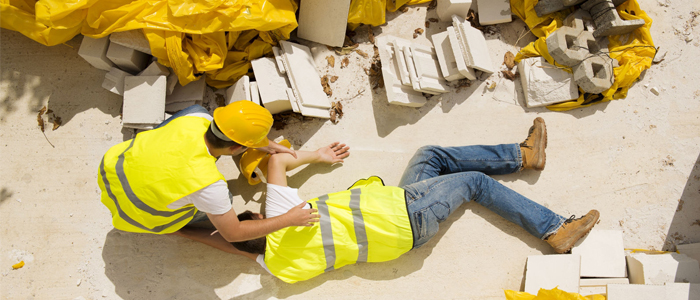
By now we should all be familiar with OSHA’s Fatal Four in construction: falls, being struck by objects, electrocutions and being caught in or between objects. These are top four causes of construction worker deaths each year.
For 2015, the breakdown was as follows:
Falls – 364 out of 937 total construction worker deaths in 2015 (38.8%)
Struck by Object – 90 (9.6%)
Electrocutions – 81 (8.6%)
Caught in/between – 67 (7.2%)
While the Fatal Four, justifiably, generally garners most of the focus when it comes to construction safety, today we are going to look at the top sources, events and exposures of nonfatal construction accident injuries. We’ll also cover some safety tips to prevent accident injuries at the construction site.
Note: Data is based on the Bureau of Labor Statistics’ 2015 Survey of Occupational Injuries and Illnesses for nonfatal occupational injuries and illnesses involving days away from work.

Top Sources of Construction Accident Injuries or Illnesses
Parts and Materials – 14,240 total cases
Building materials (8,820) were the leading source of construction accident injuries in this category with structural metal materials (2,200), pipes, ducts and tubing (2,030) and wood and lumber (1,980) being the main culprits.
Fasteners (1,720) like nails and screws were another major source of accident injuries. As were electric parts (970) which covered everything from building wiring and switchboards to generators and powerlines to power and extension cords.
Safety Tips:
- Always wear personal protective equipment (PPE) such as hardhats, safety glasses, gloves and steel or composite-toed boots
- Be mindful of your surroundings and those around you when moving materials around the jobsite
- Employ lockout/tagout procedures and depower equipment when not in use or making repairs
Worker Motion or Position – 11,010 total cases
These are self-inflicted accident injuries where the worker has hurt themselves which was caused by the position they were in or by a bodily motion such as walking, climbing, bending, reaching, twisting, etc.
Safety Tips:
- Limber up by stretching before you begin your shift
- If possible, try sitting rather than squatting or kneeling while performing work
- Don’t overextend or make sudden movements to avoid strains or sprains
- Avoid carrying heavy objects when climbing
Hand Tools – 9,640 total cases
Nonpowered hand tools (5,320) were the source of more construction accident injuries than powered hand tools (4,050). Cutting tools (1,270) like knives and boxcutters, digging tools (1,550) like shovels and striking tools (1,010) like hammers were some of the leading sources of nonpowered hand tool injuries.
For powered hand tools, boring tools (980) like drills, cutting tools (1,030) like power saws, and surfacing tools (1,080) like grinders and sanders were the major sources of construction accident injuries.
Safety Tips:
- Use the proper tool for its designated purpose
- Inspect all hand tools to ensure they are in good working order
- Always wear gloves and other PPE when using hand tools
For more tips on hand tool safety, check out Construction Safety: Working With Hand & Power Tools.
Floors, Walkways, or Ground Surfaces – 8,540 total cases
Walking surfaces like the ground (3,220), floors (2,640), and stairs, steps, and escalators (1,000) can be dangerous especially on construction sites where they can be uneven or irregular.
Safety Tips:
- Watch where you’re walking
- Be mindful of any tripping hazards or uneven surfaces
- Wear non-skid footwear to avoid slipping on surfaces
- Clean up any spills or material waste and keep walking areas clear at all times
Vehicles – 5,490 total cases & Machinery – 4,880 total cases
Highway vehicles (4,260) like freight hauling trucks and pickups were some of the major sources of accident injuries on construction sites.
For machinery, excavating machines (760) like backhoes and bulldozers, heating and cooling machines (1,060) like HVAC units and furnace, material and personnel handling machines (1,060) like cranes and aerial lifts and metal, woodworking and special material machinery (1,210) were all major sources of construction accident injuries.
Safety Tips:
- Make sure drivers or operators can see you when working around vehicles or machinery
- Block off areas where heavy machinery or vehicles are being used when possible
- Only allowed licensed or properly trained workers to operate vehicles or machinery
For more tips on working with heavy equipment, check out our Heavy Equipment Construction Safety Tips.
Top Events or Exposures Leading to Construction Accident Injuries or Illnesses
Contact with Objects – 26,550 total cases
Being struck by objects or equipment (16,260) was the leading event in this category with 6,710 being injured by a handheld object or equipment and most of those were caused by the object slipping or being swung by the injured worker (4,740). There were 5,060 construction accident injuries caused by a falling object or equipment striking a worker.
There were 6,190 accident injuries caused by workers being struck against an object or piece of equipment. Of those, 1,630 were from being struck against a moving object or equipment and 3,910 were from being struck against something stationary like stepping on an object (1,520).
There were also 2,560 construction accident injuries from workers being caught in or being compressed by equipment or objects. Being caught in running equipment or machinery caused 960 accident injuries and being compressed or pinched in shifting objects or equipment resulted in 760 accident injuries.
Safety Tips:
- Avoid areas where overhead work is being done
- Always keep your hard hat on at the jobsite
- Use tool lanyards or netting to avoid knocking tools or materials to a lower level
- Avoid wearing loose-fitting clothing that could get caught in running equipment
Falls, Slips, and Trips – 23,860 total cases
Falls to a lower level (11,150) caused slightly more construction accident injuries than falls on the same level (8,120). Slips or trips without falls were responsible for 3,980 accident injuries.
Safety Tips:
- Make sure fall protection is provided when working at height
- Inspect all personal arrest systems to make sure harnesses, connecting devices and lanyards/lifelines are in good working orders
- Keep walking surfaces clear of construction materials and debris
Overexertion – 21,960 total cases
Construction is hard, strenuous work and it’s easy to overexert yourself when carrying out daily tasks. Overexertion from lifting or lowering objects (6,250) was the leading cause of construction accident injuries in this category.
Safety Tips:
- Always wear a back brace when lifting heavy objects
- Bend at the knees and use your legs to lift objects
- Take frequent breaks when performing tasks that require repetitive motions or when you are feeling tired
Transportation Incidents – 3,380 total cases
Most of these accident injuries were from roadway incidents and vehicle collisions (2,240). There were also 790 injuries from pedestrians being struck by vehicles mostly in work zones or off the road like on construction sites.
Safety Tips:
- Always obey all traffic rules when operating vehicles on the road
- Use spotters to help notify drivers of workers in their blind spots
- Set up barricades and signs to notify highway drivers of work zones
For more safety tips, check out our 10 Road Construction Work Zone Safety Tips.
Remember, proper safety training is the number one key to preventing construction accident injuries and keeping workers safe.
Need more project leads? ConstructConnect finds you the best construction projects to bid on and win more work.