In short:
- The AI debate is over. Now people want proof. Professionals aren't asking whether AI belongs in preconstruction anymore. They want proof that it saves time and drives real results before they buy in.
- Everyone wants to get in earlier. The goal is a timing advantage. That means earlier project visibility, better market data through ConstructConnect® Analytics, and new ways to share projects like our newly launched Source Portal.
- The market is restless. Inflation, energy costs, and a long-term labor shortage are top concerns. But as our Chief Economist Michael Guckes explained, data centers and mega projects are quietly carrying construction's growth.
You can learn a lot about this industry from a dashboard. But you learn more standing at a booth at 10 a.m., coffee in hand, while an estimator tells you about the bid that kept him up last night.
That’s why we love going to industry events. We build tools for preconstruction, but the people who use them—estimators, architects, contractors, and building product manufacturers—are the ones who tell us what is really changing. This quarter took us into two very different events. That contrast ended up telling the story.
In May, we were in Phoenix for Advancing Preconstruction, the largest strategic preconstruction conference in the country. More than a thousand estimators and preconstruction leaders were there, talking about cost certainty, risk, and escalation in a market that will not sit still.
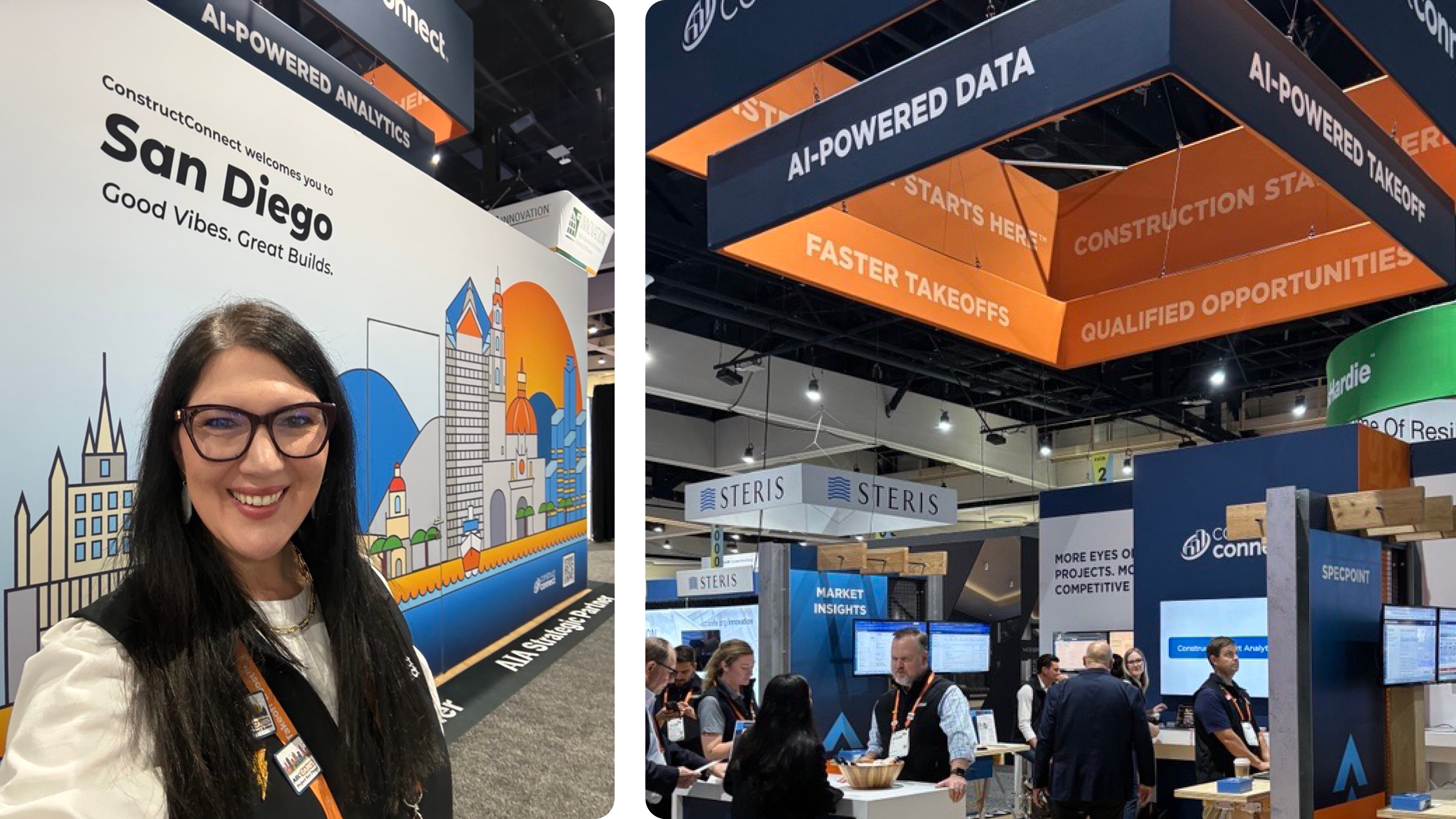
In June, we were in San Diego for AIA26, the design world’s big annual event, where architects and firm leaders were focused on a bigger question: What comes next for the practice itself?
Different crowds. Different language. But when you line up the conversations from both events, the same three themes show up.
The AI conversation moved from "Is this real?" to "Prove it"
A year ago, people were still asking whether AI belonged in preconstruction at all. That debate is over.
"AI and technology disruption was the single biggest thread running through the conference," said Howard Atkins, Executive Vice President of ConstructConnect’s Building Product Manufacturer segment who spent the week at AIA.
The keynote addressed AI head-on. Breakout sessions got specific, even covering how to tell AI-generated images from real photography. The interest is real, but so is the skepticism.
"With AI showing up in daily workflows, construction professionals are trying to figure out what hype to believe," said Jennifer Johnson, Chief Product Officer. "Some are embracing it, some are blocking it out. No one wants to get left behind, but they need to be shown solid evidence that it's worth the investment. People now know it's not a magical cure-all."
That is the standard now, and Jen is clear about what it takes to meet it:
"We are in an AI-first world moving fast toward agentic systems, embedded intelligence, and workflows that run themselves. That's where the industry is going. But speed doesn't earn trust—outcomes do. We have to prove it: in the time our users get back, in the decisions they make faster, every day, until the value is so consistent it stops being a conversation."
You could see that proof landing in real time at our booth. According to Hunter Chapman, Director of Product Marketing, the takeoff conversation has changed.
"People immediately understood the use cases," he said. "They talked about spot-checking contractor quotes, double-checking quantities, and cutting down on the manual counting that still eats up too much time. It felt less like a nice-to-have,” he said, “and more like something they could picture using Monday morning. Takeoff Boost drew the most hands-on interest.”
The takeaway is simple: people are not asking whether AI works as much as they are asking how far it can go for their trade.
The new race is to get in earlier
If there was one need that came up in both rooms, it was timing.
"By the time plans are available, it can already feel too late," Hunter said.
Across dozens of conversations, the same message kept coming up. People wanted access to private work, pre-design leads, awarded-stage intel, bidder insights, and earlier visibility into the right GCs and architects.
"More than anything, people are looking for a timing advantage," Hunter notes. “Not more volume, but a better shot at the right opportunity before the field gets crowded and the spec locks in.”
That need is showing up as demand for better data. Customers and prospects want to know which architects to target, how their spec share compares to competitors, and which markets are heating up. Those are exactly the questions ConstructConnect Analytics is built to answer, and it got strong reactions at both shows.
Howard saw the same thing from the manufacturer side. He said the crowd responded well to data-driven tools that connect early design decisions to real market outcomes.
San Diego also brought timely news on this front. The same week as AIA, we introduced Source Portal. It is a free, self-service way for architects, owners, and GCs to submit their projects directly and see who is engaging with them, instead of routing everything through emails and phone calls.
The roles around the table are shifting, too. Derek Guffey, VP of Sales for our Building Product Manufacturer segment, is watching manufacturers move beyond supplying materials into building certified installer networks. They are providing the installation now, not just the product. He notes:
"Contractors continue to become much more vital in the preconstruction process, even down to product selection. Constructability is equally important to aesthetic and performance criteria. The ability to connect early in the design process has never been more important. ConstructConnect is in a perfect position to enable communication between contractors, subs, BPMs, architects, and owners."
And underneath it all, the economy
Every one of these conversations sits on top of an uneasy market. Among manufacturers especially, Howard heard the same steady concern: inflation, energy and oil prices, and the impact of conflict overseas. AIA even had an economist giving daily updates from the expo floor.
Michael Guckes, Chief Economist at ConstructConnect, presented a session of his own: Building for Tomorrow: Trends in US Construction.
He started with the labor shortage. Michael said this is not a short-term issue, but a structural one. Population growth has slowed from nearly 1% a couple of years ago to 0.2%, pointing to a shrinking workforce in an industry that still needs people.
The numbers behind that are just as stark. Since COVID, the economy has seen a steady rise in the portion of people who have found themselves out of work for six months or longer, a trend we have not seen in decades.
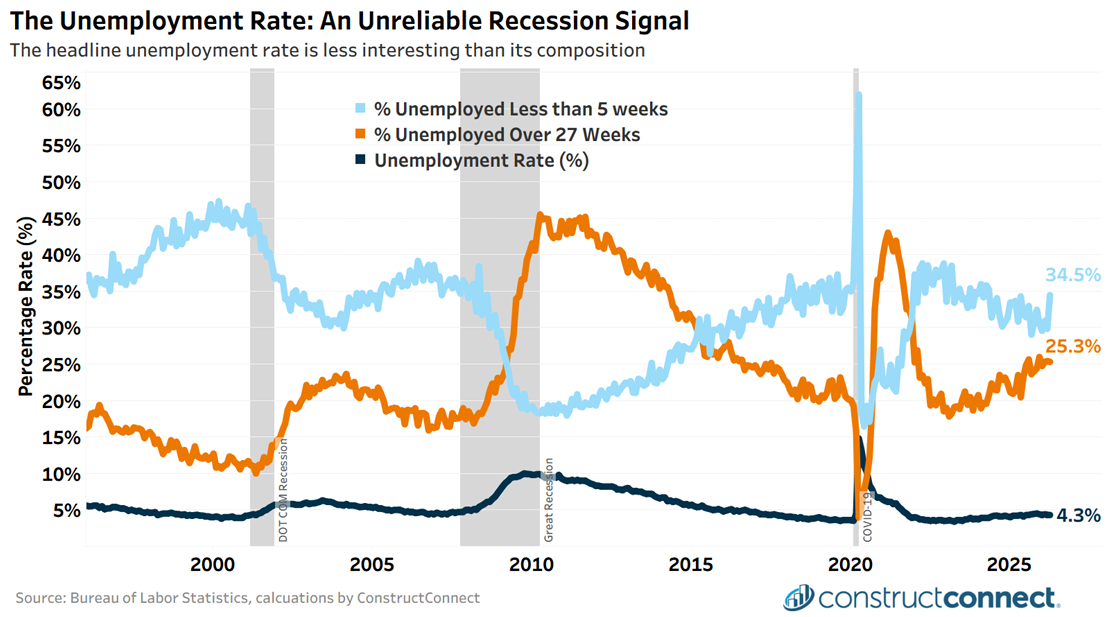
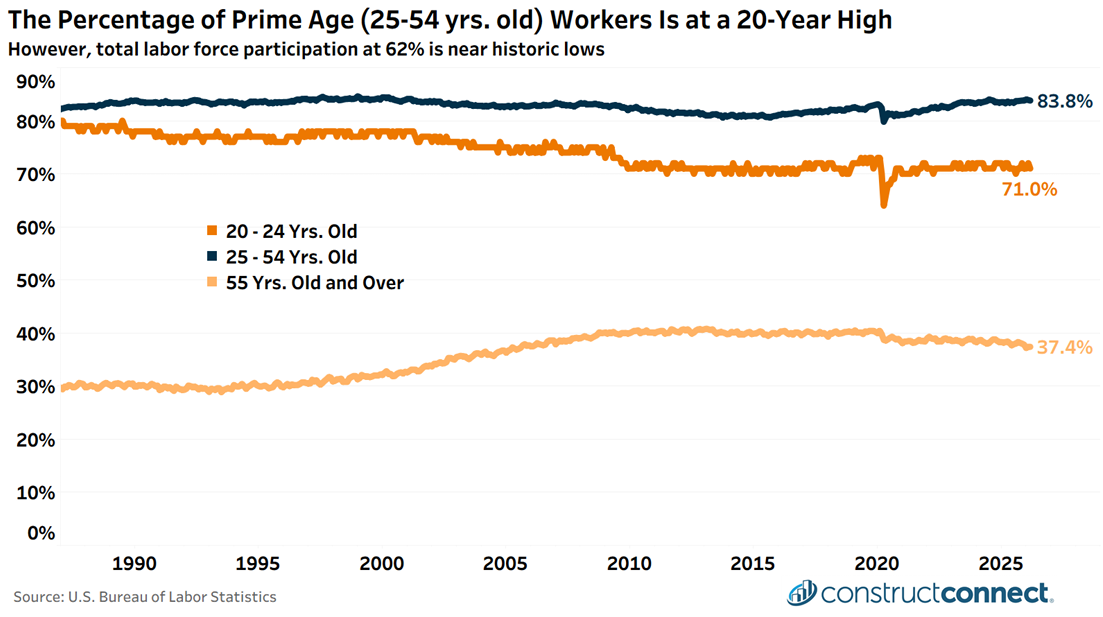
Labor force participation among 20-to-24-year-olds has slipped to 71%, while older and core-age workers are maximally involved, according to historic norms. His advice was blunt: poaching is no longer a real strategy. If there is a silver bullet to this problem, business owners have yet to find it and then apply it at scale.
Then there is the sector driving growth: data centers.
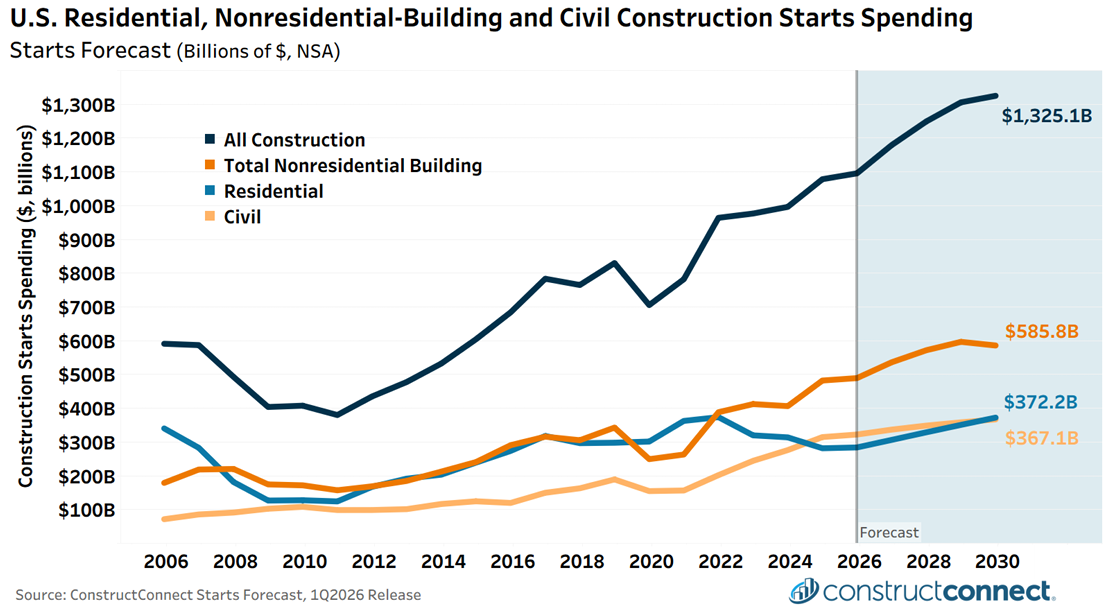
Michael showed just how much they have taken over. Last year, of roughly $90 billion in "office" construction, about $81 billion was data centers. They have gone from one-fifth of that category to nearly 85% of it.
"When we talk about office spending, we don't really mean traditional offices anymore," Michael explains.
Data centers now account for over 25% of all non-residential building spending. The larger data center ecosystem, including power generation, power transmission, and water and sewer work, is carrying overall construction growth almost by itself.
For anyone worried they missed the window, his take was encouraging. He does not expect data center starts to peak until around 2029, near $191 billion. Given this outlook, there remains time for firms to make smart investments and get on this train.
Mega projects tell a similar story. In 2025, nearly $200 billion in mega projects broke ground, up roughly 75% over the prior few years. 2026 is already outpacing it, with about $60 billion started through March alone.
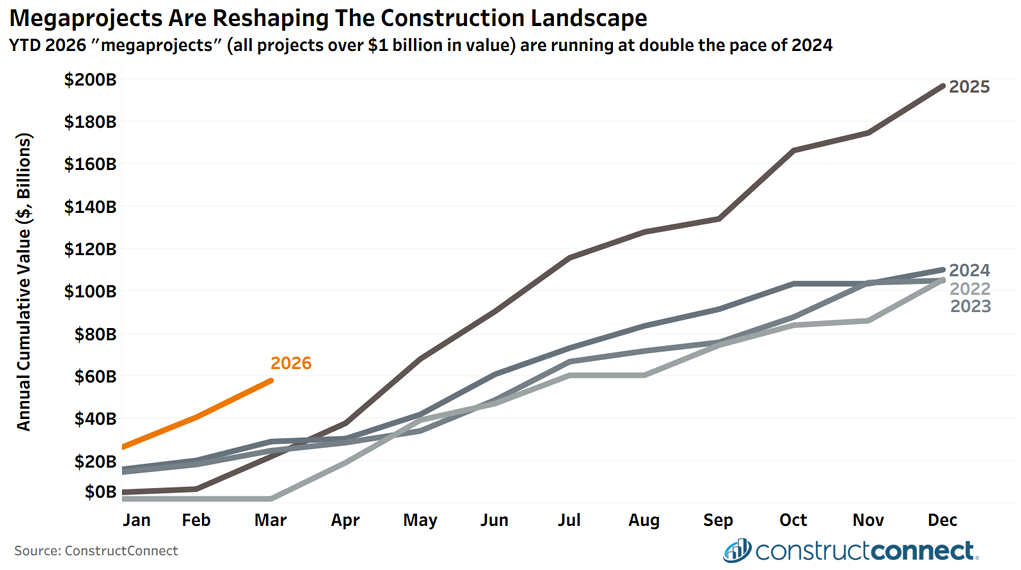
More than a quarter of all construction starts now come from these billion-dollar jobs, up from the low teens just a few years ago. Data centers, billion-dollar hospitals, sports and convention venues, even prisons. The billion-dollar project is becoming the new normal.
The wild card is cost. Michael’s biggest open question was energy. Materials inflation had already climbed to around 6% because of tariffs, and a roughly 63% jump in energy prices tied to conflict in the Middle East was adding even more pressure.
Energy does not just raise fuel bills. It affects everything, because it takes enormous heat to make materials like glass and insulation. If the conflict settles and stays settled, he expects inflation to land closer to that 6% mark. If not, the ceiling is anyone’s guess.
His closing advice fit the moment: pick your end markets and geographies carefully, because the opportunity is real but uneven. There is still time to get into data centers and AI-driven work. And solve your own labor problem, because the market will not solve it for you.
Michael’s AIA message was not just that data centers and mega projects are driving growth, but that firms need to watch where opportunity is opening up beyond the biggest headlines. That is the thread he continues in The Midwest Manufacturing Renaissance That No One is Talking About. He highlights growth outside the data center ecosystem as a reminder that real demand is still taking shape in other corners of the market.
What it all adds up to
Step back from two very different rooms and the same picture comes into focus. Hunter summarized it best:
"With rising competition and economic pressures, those across the construction industry are looking for ways to get involved earlier, move faster, and spend less time chasing the wrong work. That underlying need was consistent across manufacturers, contractors, developers, and design firms: construction professionals are looking for tools and solutions that help them solve these needs without adding complexity to their workflows."
Whether you design the project, supply it, or build it, the goal is the same: a better shot at the right work, earlier in the process, and proof that the tools you adopt truly earn their keep.
That is who we build for. And it is why, every quarter, you will find us back on the floor, coffee in hand, listening.