In Short:
-
Construction remains uneven, with data centers offsetting declines elsewhere.
-
Rising materials, fuel, wages, and borrowing costs are squeezing contractors.
-
Construction starts may grow 6.9% in 2027, but pipeline risks remain.
Between rising material prices, costly loans, and answers that differ depending on who you ask, there’s a lot competing for your attention in the construction industry … but not enough time to sort through it all, right?!
That’s precisely why the Chief Economists from ConstructConnect®, the American Institute of Architects (AIA), and the Associated General Contractors of America (AGC) come together twice a year for the Construction Economy Outlook webcast. They help cut through the noise, to give you a clear picture of what’s going on economically in construction right now, and what to expect tomorrow.
The experts recently wrapped up the Fall 2026 edition. Here’s what you need to know, in plain language.
You can also watch the recording or flip through the slides.
Two Economies at Once, AKA a “K-Shaped Economy”
Construction isn't collapsing, but it isn't booming either.
"It's surviving, but certainly not thriving," AIA Chief Economist Richard Branch says.
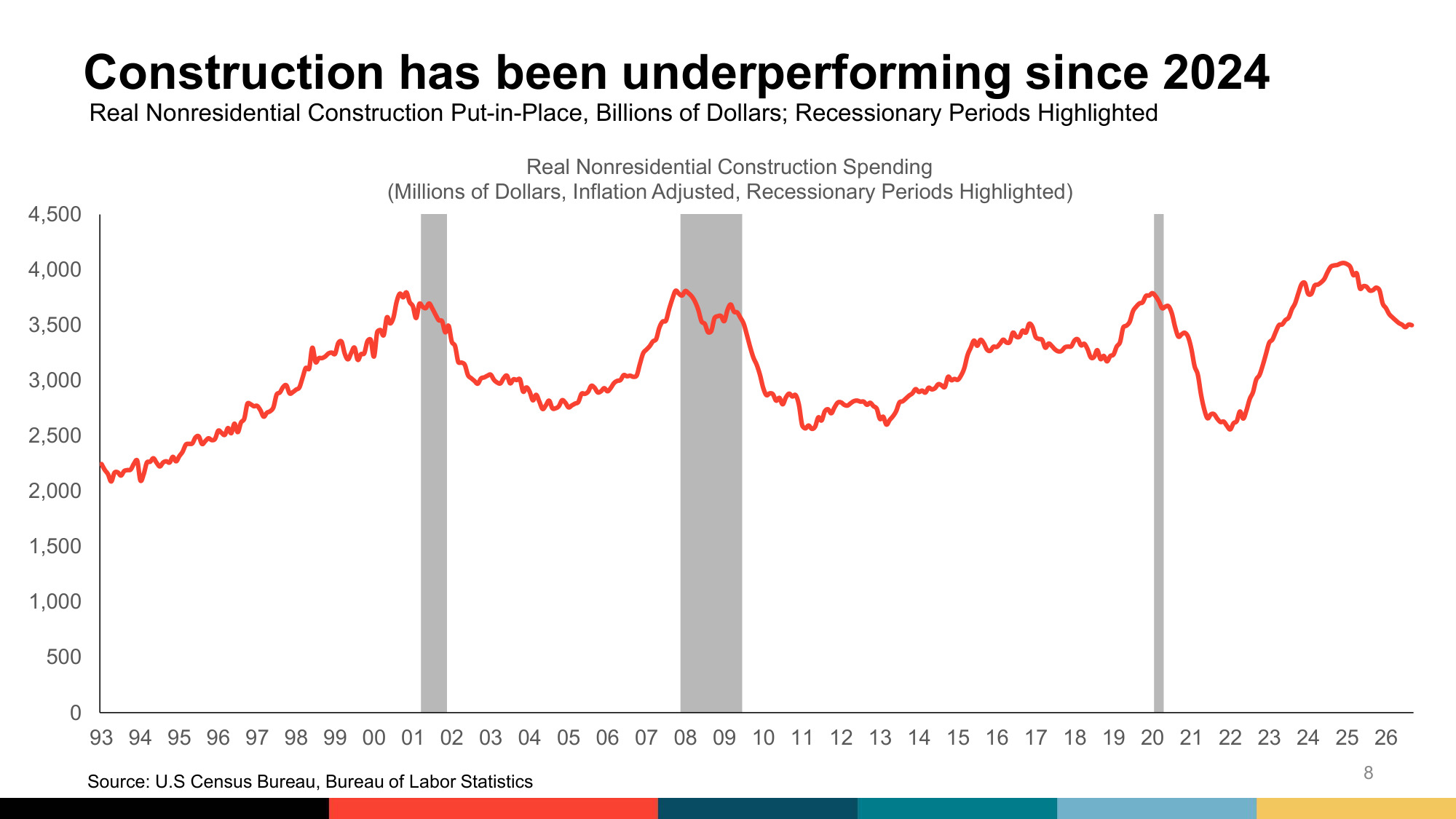
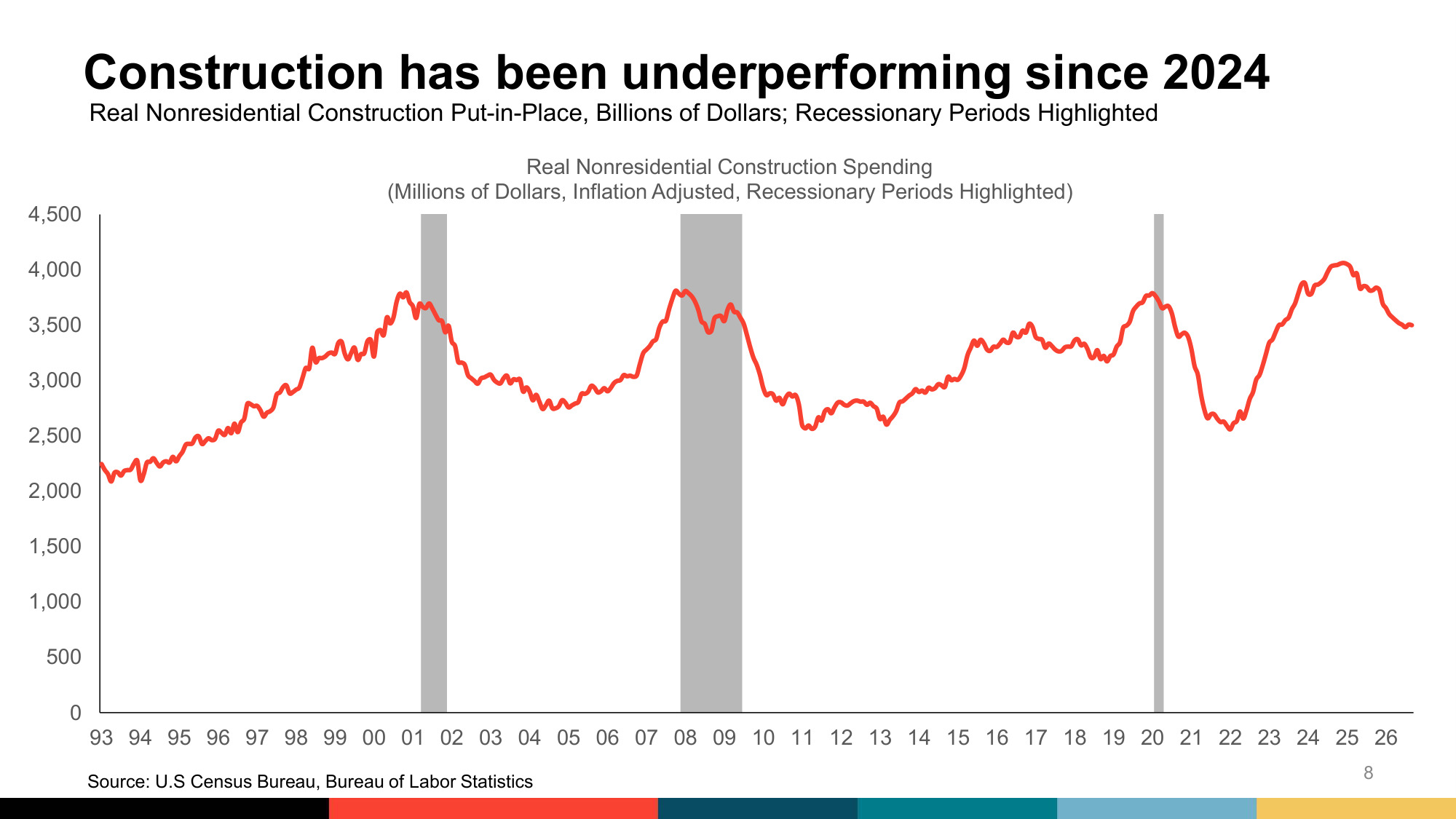 Inflation-adjusted spending on nonresidential buildings (think offices, warehouses, schools, and hospitals) has slipped for about two years, though Branch says it may finally be bottoming out.
“This is an economy that is not collapsing, but it sure doesn't feel like one that's particularly robust as well,” Branch adds.
Economists call this a "K-shaped" market, referring to how the letter “K” looks. Some sectors and regions climb (the top part of the K), while others are pointing down and falling (the bottom part of the K).
"Two things can be true at the same time, right?” Branch reflects, “We are clearly dealing with two different economies.”
Yes, Data Centers Are Holding Up the "K," but …
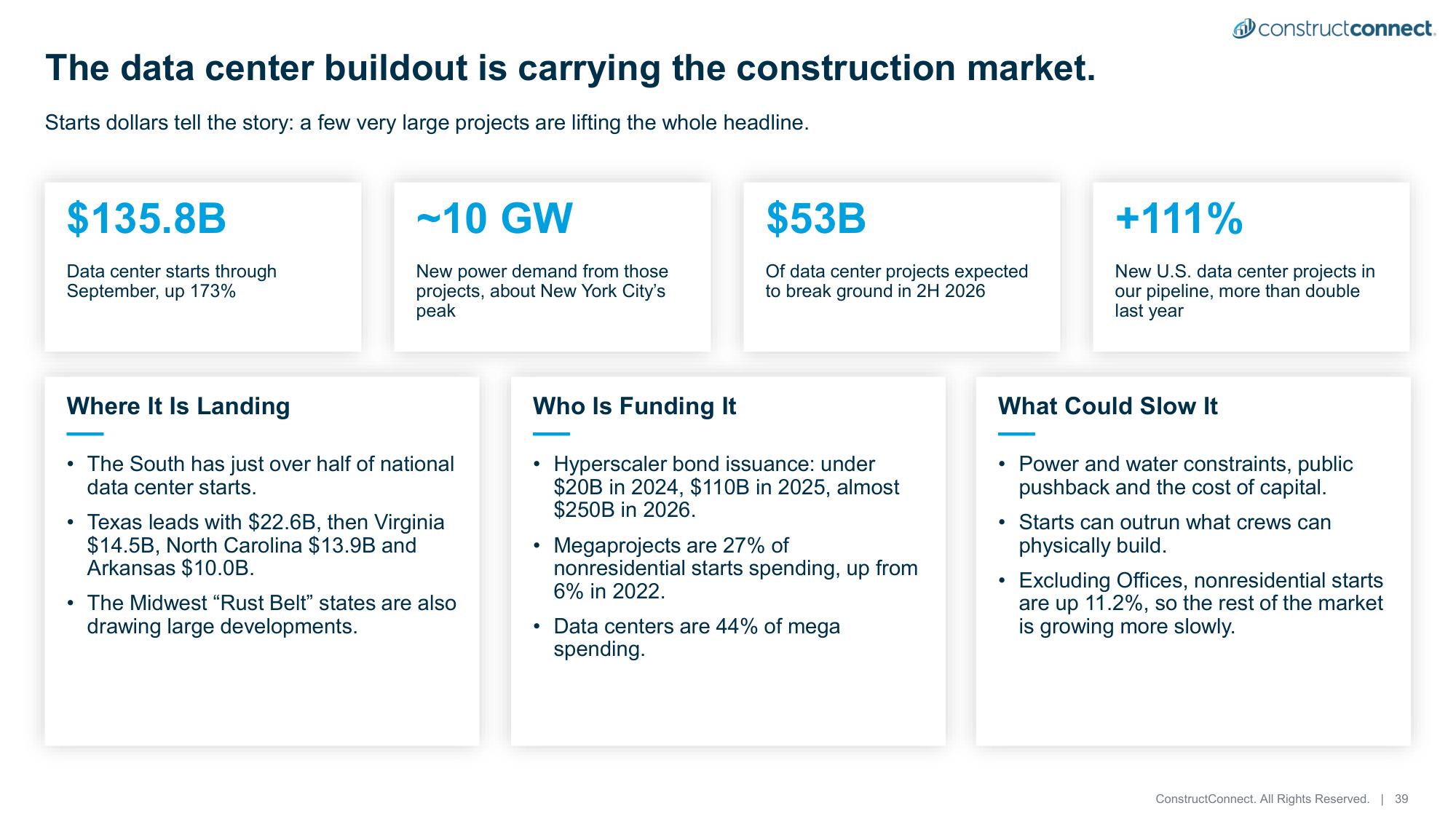
The upward arm of the K is from data centers, the huge buildings packed with computer servers that power AI and cloud services. ConstructConnect data shows data center "starts" (meaning projects actively breaking ground) reached $135.8 billion through September 2026, up 173% from last year.
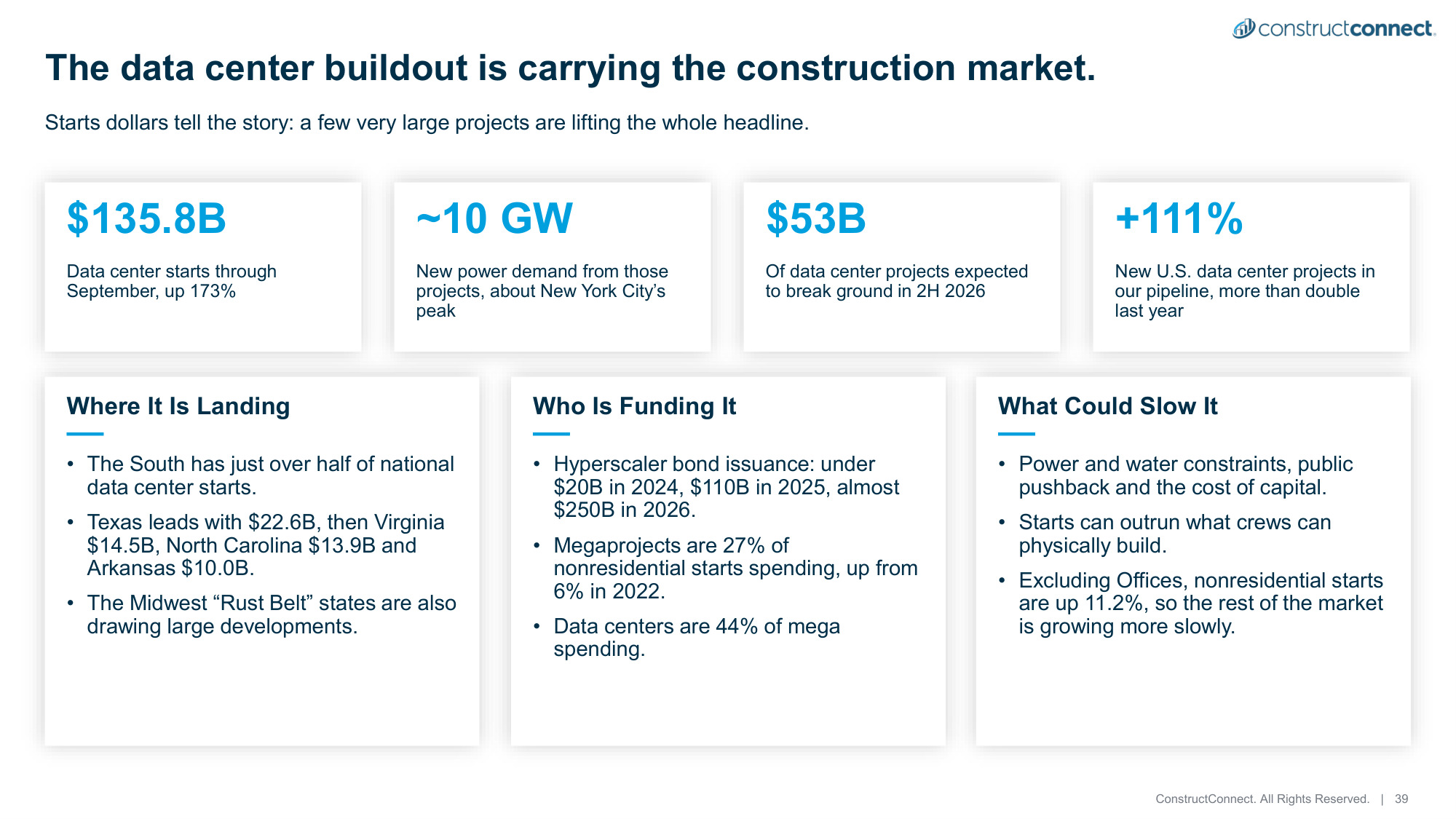 Megaprojects, builds that cost $1 billion and up, now account for more than one out of every four nonresidential construction dollars.
For smaller firms, that cuts two ways. While ConstructConnect Chief Economist Michael Guckes says, "Who you know in the industry matters a little bit more than just, you know, what you can do," He adds that there can be rewards for those who dig deeper.
“And I think [data centers dominating our attention is] simply because the news, the media is so focused on data centers and understandably so," Guckes suggests. "But there's a lot of opportunities that if you're looking beneath those top-level numbers, if you're looking past the simple headlines, you can find a lot of opportunities still exist within construction.”
Why Interest Rates Matter
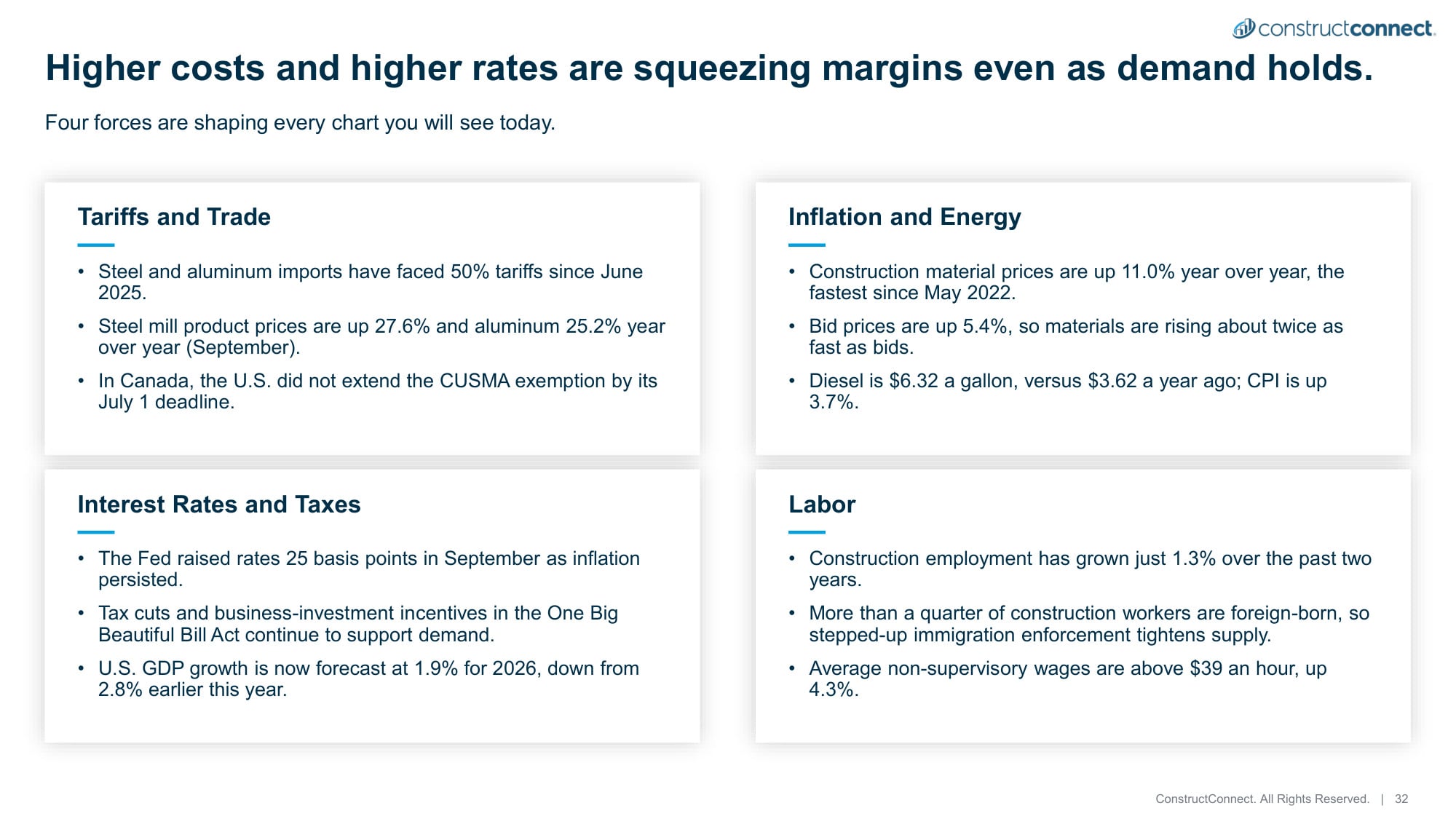
When the Federal Reserve raises interest rates, borrowing gets more expensive. The Fed raised rates 25 basis points (a quarter of a percentage point) in September 2026. For an owner or developer, a pricier loan can turn a "maybe" project into a "no," which means fewer jobs to bid.
Housing is where this impact is being felt the most, according to Branch.
"I think [a 6% interest rate] gets us stability in single family starts. I think 5.5% gets us growth."
The 30-year mortgage rate, meanwhile, averaged 7.11% on the day of the webcast, according to Freddie Mac data cited by AGC Chief Economist Ken Simonson.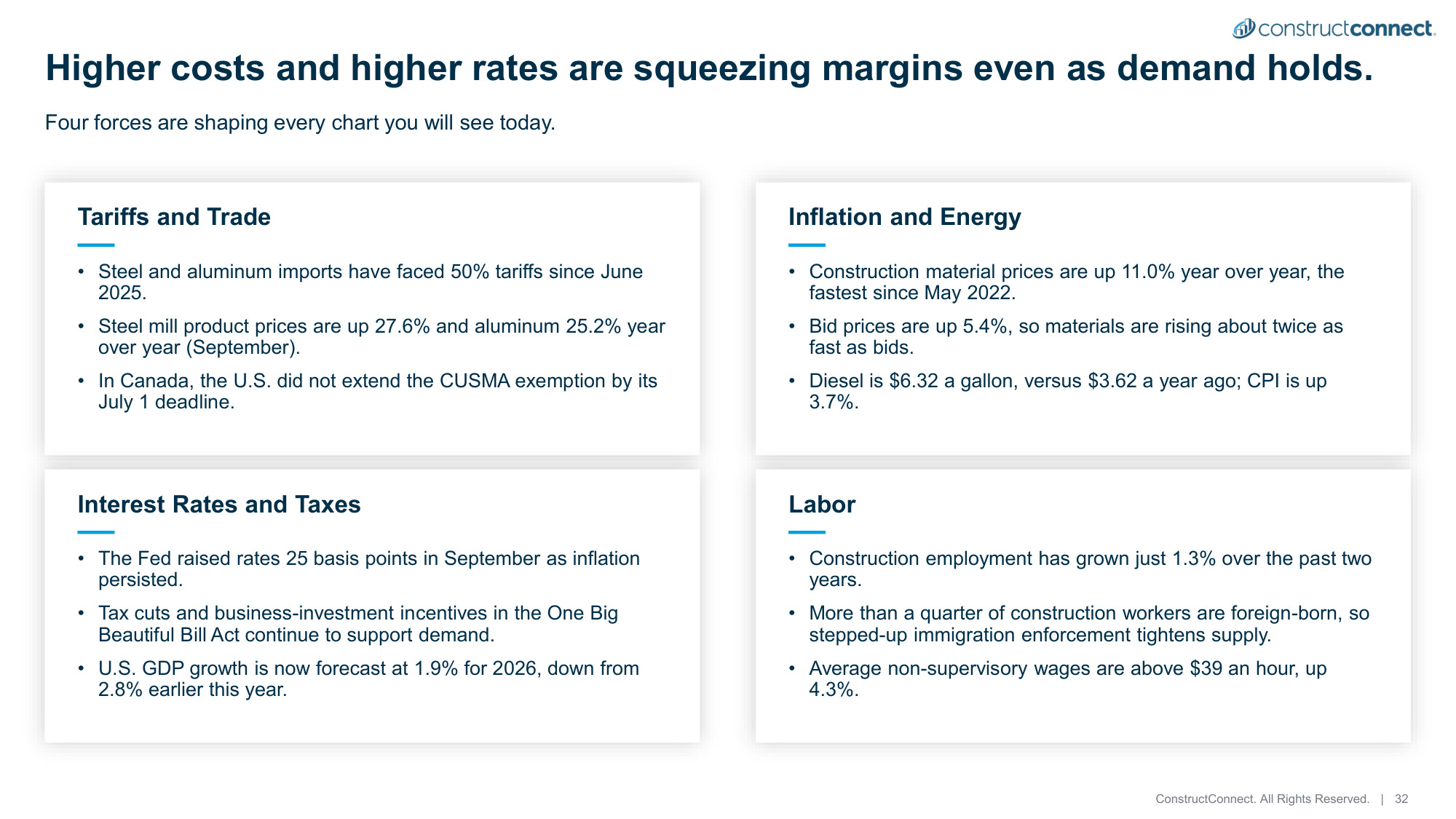
Costs Are Climbing Faster Than Bids
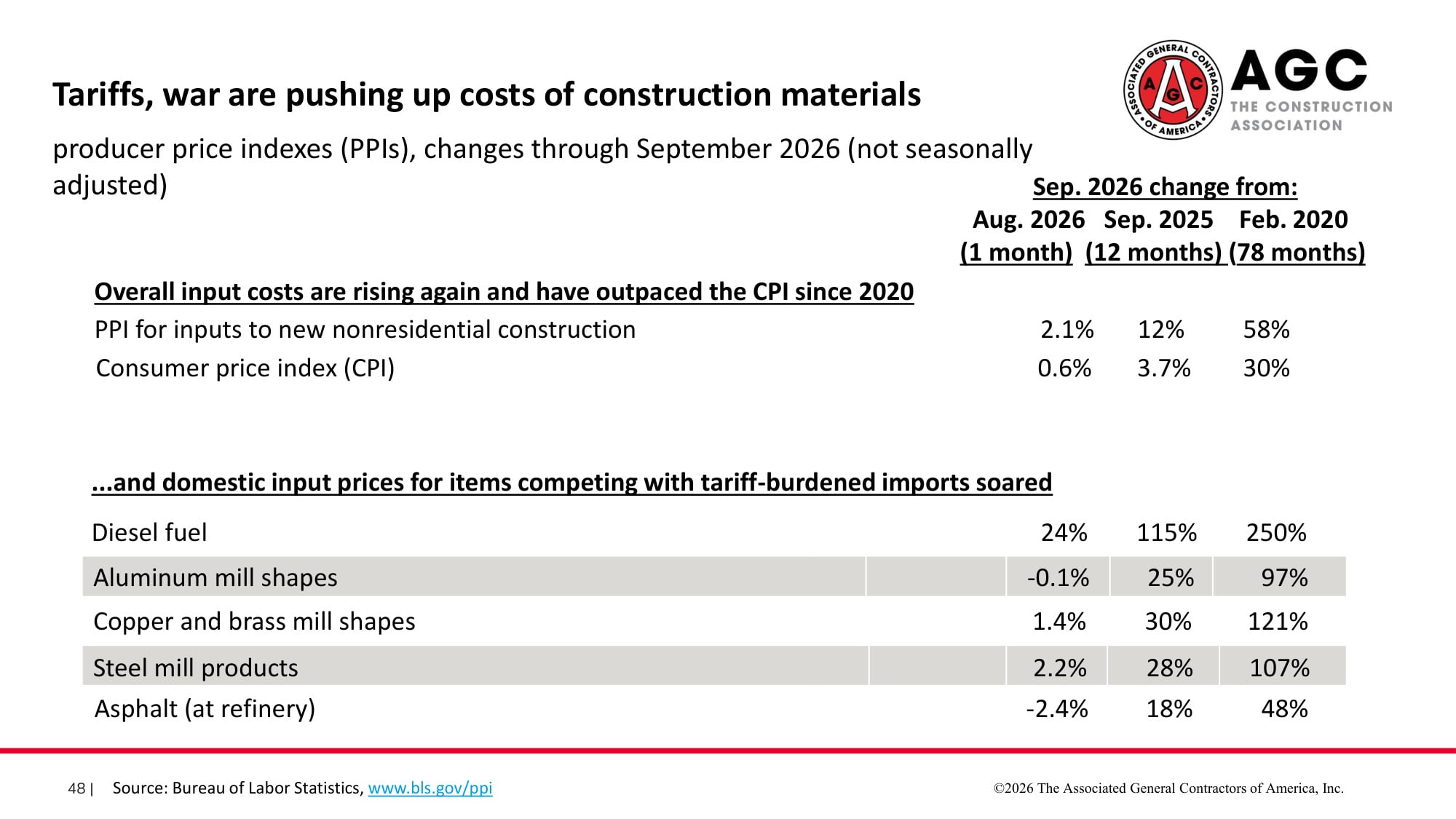
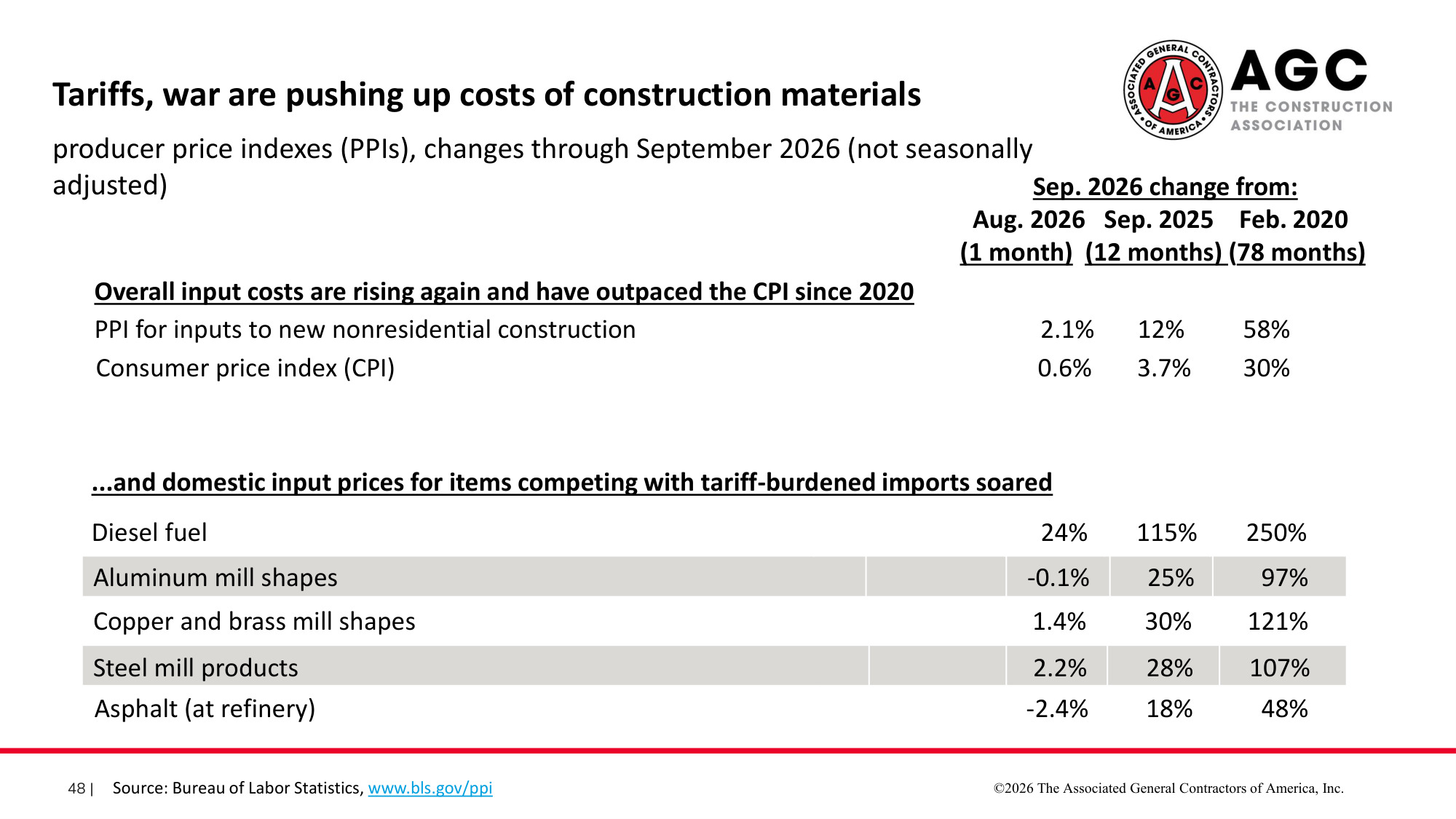
Our experts noticed producer prices (what manufacturers charge for materials) have gone up between 11% and 12% over the past year, while bid prices rose just 5.4%.
That means contractors are paying more to build than they're charging to bid, which squeezes margins. Tariffs of 50% on steel and aluminum and diesel at $6.32 a gallon, versus $3.62 a year ago, are big reasons why.
Pay is rising too. Construction hourly wages are up 5.2%, compared with 3.3% for the private sector overall.
What to Expect in 2027
The outlook for 2027 is better, but it's still uneven. ConstructConnect forecasts total U.S. construction starts to rise 6.9% in 2027, with the economy growing 2.4%. AIA's forecast panel expects nonresidential building spending to grow 3.0%, though Branch admits the risk leans to the downside.
While bidding is up 4.5% in 2026, new projects entering planning are down 17.9%, so the pipeline is thinner.
Kristy O'Brien, ConstructConnect's Director of Content Acquisition, says, "2026 is a strong market but it is not a uniform one."
Simonson agrees but is blunter.
"I have never seen more uncertainty, more volatility," he says.
How to Compete: See Work Early
O'Brien's advice for small and midsize businesses is, "[Your] first advantage is really to see work early."
Guckes agrees with this. He says, "When you think about how to grow your business, how to compete, it is in large part right now about how to outthink your competition, not just outworking them."
That's where ConstructConnect Project Intelligence can help you outthink your competition. With Project Intelligence at your side, you can find, qualify, and bid on commercial projects at all stages; filtering them to your unique trade, location, and project type. So, instead of chasing the national average, you can target the categories and regions where work is actually growing.
Go Deeper: Join the Next Event, Read a Full Breakdown at ConstructConnect News
Want the full breakdown, with more data and quotes from every speaker? Read our recap over on ConstructConnect News.
Then save your seat for the Construction Economy Outlook Spring 2027 webcast on May 13, 2027, 1:00 to 2:30 p.m. Eastern. Registration is already open, and you can reserve your spot here.
Frequently Asked Questions (FAQ)
What's the difference between construction "starts" and "spending"?
Starts count a project's full value on the day it breaks ground. Spending spreads that money out over the months it takes to build.
Is U.S. construction in a recession?
The U.S. economy isn't technically in a recession, but AIA Chief Economist Richard Branch notes that real (inflation-adjusted) construction activity has been declining for about two years.
Will interest rates come down in 2027?
AIA Chief Economist Branch sees loosening as more of a second-half 2027 story, and only if oil prices cool and inflation eases.
Are data centers in a bubble?
The panelists don't think so. AIA Chief Economist Richard Branch calls it "a cooling story, not a collapsing story," while ConstructConnect Chief Economist Michael Guckes says he'll be watching how data centers are being financed.
When is the next Construction Economy Outlook webcast?
May 13, 2027, 1:00 to 2:30 p.m. Eastern. Register here.