In short:
- Understand when it makes sense to lean into public work versus private jobs based on risk, margins, competition, and payment.
- See where public demand is really growing—especially data centers, power, transportation, and large institutional or defense campuses, so you’re not chasing the wrong work.
- Learn how to use ConstructConnect’s economic tools, and its data and bid management platform for contractors, ConstructConnect® Project Intelligence and Bid Management, and Quick Bid®, ConstructConnect’s estimating software for estimators and general contractors. See how these platforms can work together to target, price, and bid the right mix of projects without guessing.
If you are a general contractor planning the next two or three years, you are probably asking the same question as your peers:
Should you lean harder into public/government work, stay focused on private commercial, or keep a blend, and how do you decide without guessing?
We will focus on practical, data-backed moves for planning and bidding, with insights from ConstructConnect Chief Economist, Michael Guckes, and Shane Vitatoe, Sr. Director, Contractor Customer Success, to get a better understanding of the market outlook and how it will shape your work.
First, it is important to define what a government project is and what makes it different from private projects.
What Counts as a Government or Public Project?
For a general contractor, a government or public project is any job where the owner is a public entity. For example, a federal agency, state or provincial department, county or city, school district, public university system, public hospital authority, transit agency, or utility district.
The funding ultimately comes from public sources such as tax revenues, bonds, or grants, and the procurement process is governed by formal laws and procurement codes.
According to Vitatoe, in the next 2-3 years, general contractors will see a lot of public opportunities, but one seems to outweigh the others:
“For our larger contractors, there are these megaprojects they are working on, so data centers, things like that. We met with JE Dunn a couple of months ago, and they are really attacking those larger projects.”
Other typical examples of public projects include:
- Transportation and civil infrastructure – highways, bridges, roads, transit, airports, water and wastewater systems.
- Water, power, and grid upgrades – substations, transmission lines, distribution networks, and resilience projects supporting data centers and manufacturing growth.
- Institutional and civic buildings – K–12 schools, higher education buildings, courthouses, public safety facilities, and some hospitals and clinics.
- Security and defense campuses – such as NGA West, a 97acre campus with a main operations building, utility plant, parking garages, visitor control center, and secure access points, all delivered under tight security and performance requirements.
Key Differences Between Public and Private Work
When a contractor first steps into government work, one risk is treating public work like private work with more paperwork, but public projects are different in more than just the forms filled out.
Public projects are bound by law and procurement codes, with defined invitation for bid, request for proposal, or request for qualifications processes. They tend to also have strict rules on timelines, addenda and questions. Plans, specifications, addenda, plan holder lists, and often bid results are visible after opening. Private projects involve owners that can run invite-only, negotiated or best-value selections with more flexibility and there is limited transparency into who else is competing or how awards are decided.
The difference between the two is mainly in competition between bidders as well. Public projects can create more competition with margins tending to be thinner and payment being slower, but once funds are given out and work is accepted, credit risk is typically lower. As for private projects, they are more relationship-driven with room for higher margins on work as well as payments moving quicker, but owners carrying more market risk.
As a general contractor, you must decide what decision to make when investing time in either type of project. Chief Economist, Guckes recommends working with the best available resources to find and bid on projects that make the most sense for your business.
“Would you want to compete against yourself in that future state where you worked for the last year to become very AI capable? The time savings, the money savings, those are going to be substantial, and you are going to be a company that can undercut. You can put in a more competitive bid and again you’re going to win because you worked smarter not harder.”
Project selection can make a critical difference between a profitable job versus an unprofitable one. Guckes described a state of clarity to reduce uncertainty in project selection.
“The more niche you are, the fewer opportunities you will have to submit a bid you really like, but then again, if you become a little more general and open yourself up to maybe a more competitive environment, you will probably also find more projects.”
One secret, Guckes said, is finding what is right for you in your business. “You have to balance the quantity of projects with the number of projects where you really feel that you are going to get a healthy margin out of the work.”
What Today’s Economy Means for Government Public Work
ConstructConnect’s recent economic coverage points to a few themes that matter if you are weighing government work. After a couple of years of nearly three percent growth, the United States economy is expected to slow but not fall into recession. That slower pace puts more pressure on you to be deliberate about where growth is intended.
At the same time, the market is splitting. Roughly half of tracked nonresidential subsectors are still expanding, while the rest are flat or shrinking. Data centers, manufacturing, sports and convention facilities, and airports are among some of the brighter spots, even as some power, hotel, and medical categories soften. On top of that is the rise of megaprojects. The NGA West campus in St. Louis is one example—a $1.7 billion, 97acre intelligence campus that shows how federal investment, complex security requirements, and long timelines come together on government work. You can see more detail in this National Geospatial Intelligence Campus megaproject spotlight. Guckes emphasizes this rise in megaprojects.
“Data centers and power infrastructure are the two big ones. We saw data centers almost tripled last year from around $28-29 billion and it was roughly $77 billion at the end of 2025.”
Wage growth has been running above four percent year over year, and material prices have climbed more than five percent, which puts strain on already tight margins. ConstructConnect’s Construction Economy Snapshot, Construction Starts Forecast, Expansion Index, and Project Stress Index (PSI) take these moving pieces and turn them into data you can work with. The Expansion Index shows where planning volumes are rising or declining by state, province, and metro area, so you can see whether civil, institutional, or industrial work is building in your footprint. The PSI tracks projects that are delayed, put on hold, or abandoned over the last 30 days and often reveal different stress patterns for work.
With these tools, you can increase your chances of winning more public work. Vitatoe highlights what you should prepare for to not make any mistakes during the bidding process.
“You want to make sure that you have enough subcontractor bids to keep your margins low. You don’t want to be overextended or not be putting together a solid bid or else you will never win because it’s hard bidding and low bid always wins, but you also don’t want to be too low. So, you want to make sure that you are keeping up with addenda, making sure your subs are keeping up with all the updates that go along with those public projects. Look at the requirements for wherever they are bidding. If it is city to city it can vary, like minority business percentage that needs to be invited to those projects.”
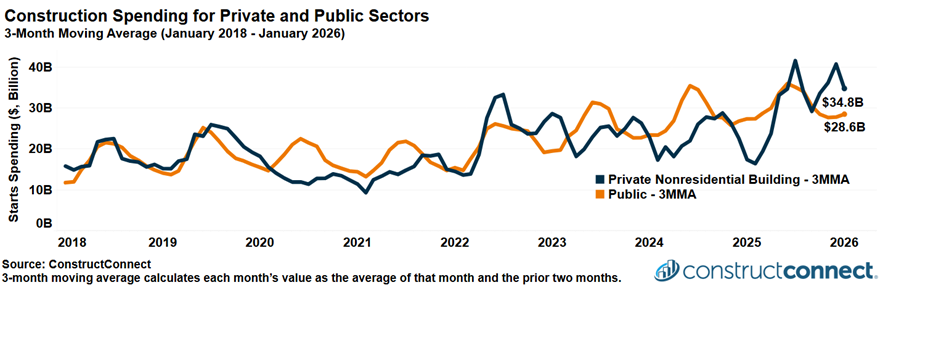
This chart compares public construction starts, which include both nonresidential buildings and civil/infrastructure projects funded by government, with private nonresidential building starts, which are nonresidential projects excluding heavy engineering work. Both series are shown as a three-month moving average, meaning each point is the average of the current month and the prior two months, which smooths out month-to-month volatility.
Turning Construction Economics into a Public Work Strategy
Once you have a sense of where the market is heading, the next step is to look at real projects and see how they line up with your strategy. That is where ConstructConnect® Project Intelligence changes the day-to-day experience of tracking work. Instead of bouncing between dozens of city, county, state, federal, and plan room websites, Project Intelligence gives you a single, searchable database of public and private commercial projects across the United States and Canada, with hundreds of thousands of active projects and thousands of updates every day. Vitatoe mentions some of the ways in which Project Intelligence can help you streamline the bidding process.
“If they are wanting to expand their footprint, they can absolutely see what is happening in surrounding markets. We are always going to be delivering nationwide coverage. We are also going to be introducing some new analytics tools within the next six months, so say they are in Cincinnati, Ohio and they are focused on the tri-state, but maybe want to go further west or east, they are going to be able to check through our historical data just to see who is hot in those markets from a general contractor perspective.”
With this information, you are more prepared to win projects, and you do not have to navigate that decision alone. ConstructConnect products are designed to help your workflow. As you have learned, ConstructConnect Project Intelligence helps track the right mix of public and private projects by sector, geography, size, and phase, then stay ahead of changes with saved searches and alerts. ConstructConnect Bid Management streamlines how you manage invites, documents, and communications, so your team spends more time on high-value opportunities and less time digging through email. Quick Bid® by ConstructConnect helps you build consistent estimates faster, apply your own labor, material, and markup strategies, and see the impact of changes before you submit.
Whether you lean harder into government projects, strengthen your private pipeline, or keep a blend of both, having an informed strategy will help you apply a reliable, data-backed process for choosing, pricing, and winning the right mix of public and private work.
Frequently Asked Questions